
Top Signs You Need Garage Door Service – Don’t Ignore These
A garage door that takes two seconds longer to open than it did six months ago isn’t “aging.” The opener motor is compensating for increased resistance, and it’s burning hours off its lifespan every single cycle. The signs that a garage door needs service are rarely mysterious. They’re just easy to talk yourself out of, because the door still opens, still closes, still gets the car out in the morning. Here are the signals worth acting on before “it still works” becomes “it stopped working in the driveway.” If you’d rather not diagnose it yourself, call (833) 654-0980 and we’ll take a look.
Why Is the Door Moving Slower Than It Used To?
Slower movement is the single most common early warning sign we see, and it’s almost never the opener’s fault. When a torsion spring starts to weaken, it stops lifting its share of the door’s weight. The opener motor quietly picks up the slack. That extra work shows up as a door that labors, an opener that sounds louder, and a motor running hotter than it was designed to.
Think of it as a mechanical event already in progress. The spring is losing tension cycle by cycle, and the opener is absorbing the difference. Eventually one of two things happens: the spring snaps, or the opener’s gears wear out from carrying a load they were never meant to carry. Both are more expensive than addressing the spring when you first notice the drag.
- The door moves sluggishly from the moment it starts to lift, not just at the top.
- The opener motor sounds strained or grinds where it used to hum.
- The door hesitates briefly before it starts moving at all.
- You’ve adjusted the opener’s force setting to get it to close. That’s the motor telling you something.
On a LiftMaster or Chamberlain unit, the motor is generally tough enough to mask a weakening spring for a while, which is exactly what makes the symptom easy to dismiss. In our experience, a slow door is a countdown, not a quirk.
What Does Uneven Door Movement Actually Mean?
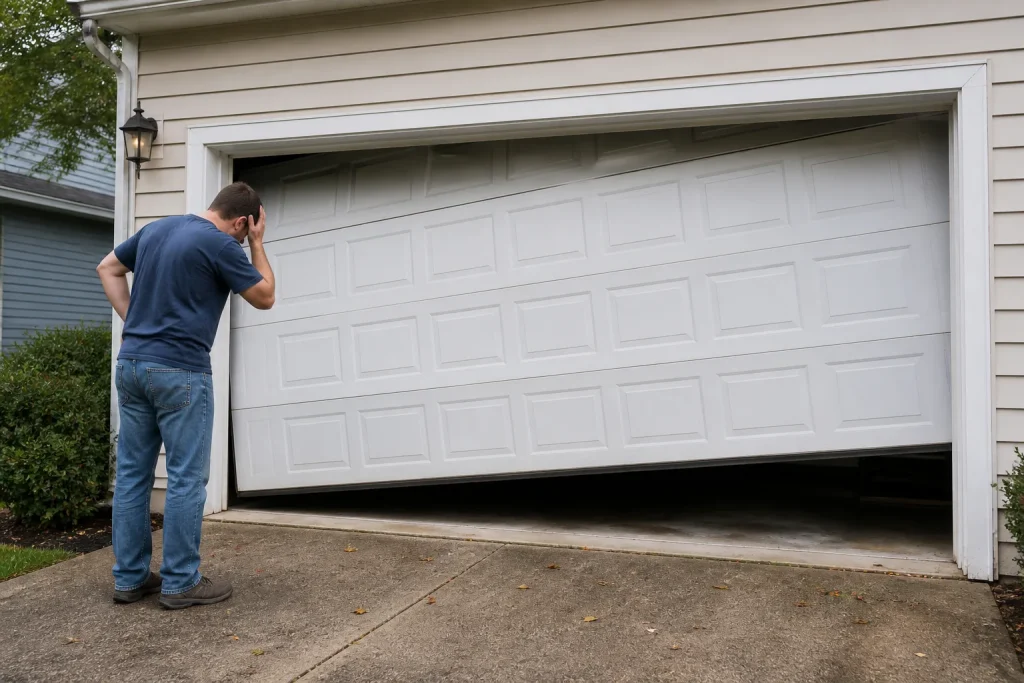
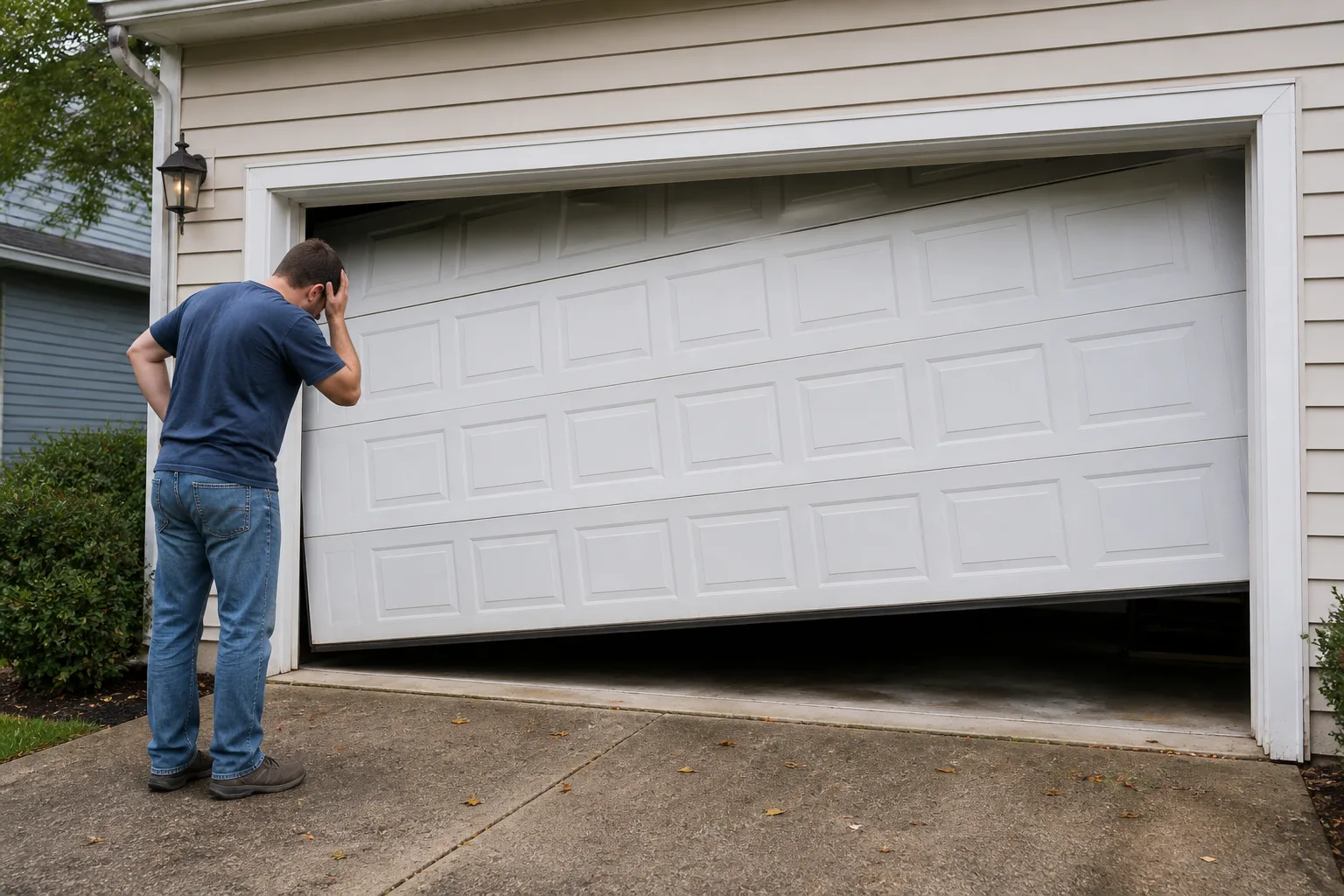
A door that rises crooked, with one side lagging behind the other, is telling you which component is failing. It’s not a vague “alignment issue.” It’s specific hardware, and the side that lags points to it.
- One side noticeably lower or slower: a torsion spring or cable on that side has lost tension or stretch. A matched pair of springs wears at slightly different rates, so one side gives out first.
- Door binds partway up and shudders: a roller is worn, a hinge is loose, or a track has been nudged out of plumb. Usually the side that binds is the side with the damaged roller or bent track.
- Door shifts sideways as it travels: a cable has jumped its drum or a track has shifted. This one gets dangerous quickly because the door can come down unevenly.
- The door tilts at rest, sitting closed: a broken or badly stretched cable, which is a stop-driving-it situation.
This matters mechanically because an uneven door puts twisting force on the panels, the hinges, and the opener’s rail all at once. Left long enough, a crooked door becomes a bent door. In Elizabeth, we see plenty of Wayne Dalton and Clopay doors with panels that were fine until months of uneven travel stressed the joints.
Why Is the Gap at the Bottom of the Door a Bigger Deal Here?
If you can see daylight under a closed door, or slide a piece of paper under it and it comes back wet, your bottom seal has failed. The seal is a rubber or vinyl strip that compresses against the floor, and it wears out from constant contact, sun exposure, and the freeze-and-thaw cycle that a New Jersey winter puts a door through. When it hardens and cracks, it stops sealing.
Here’s what homeowners underestimate. The bottom seal isn’t just about drafts. It’s the barrier keeping water, cold air, insects, and small rodents out of the garage. A failed seal lets meltwater and rain wick under the door, where it sits against the bottom panel and the floor plate. Over a few seasons that’s rust on a steel door and rot at the frame.
Do the gap test in daylight: close the door, stand inside, and look for light along the floor. Check along the full width, not just the middle. Then run your hand along the seal itself. If it feels stiff, cracked, or has chunks missing, it’s done. Replacing a bottom seal is one of the least expensive garage door services you can schedule, and it protects the panels that cost real money to replace. Elizabeth’s wet winters and humid summers are hard on seals, so this one’s worth checking every fall.
Should You Worry About Frayed Cables?
Yes, immediately. A frayed cable is a time-sensitive safety issue, and it is one of the few garage door problems that can hurt someone. The cables are under high tension at all times, and a strand that’s starting to break is a strand that’s about to break all the way. When a cable snaps, the door drops or slams without warning. There is no polite warning stage.
You can spot cable wear without touching anything. Look at the cables running along the sides of the door and over the drums at the top. What you’re checking for:
- Frayed or separated strands sticking out from the cable like a worn rope.
- Kinks, birds-nesting, or slack where the cable should be tight.
- Rust or discoloration along the cable’s length.
- Cables that have come off the drum or are sitting unevenly on it.
This is the point where we tell people plainly: do not try to fix a cable or a spring yourself. Those components hold stored energy that can release instantly. Cable and spring work is a trained-professional job, full stop. If you see a frayed cable, stop using the door and get it looked at. Our garage door spring repair covers the spring side of this, and cable work gets handled at the same time because the two systems share the same load.
Why Does the Opener Work Sometimes and Not Others?
Intermittent opener problems make people feel like they’re losing their minds. The door works, then it doesn’t, then it works again. There are two common causes, and they look similar from the driver’s seat but they’re very different problems.
Sensor misalignment is the easier one. The safety sensors at the bottom of the door (the two small lenses on either side) need a clear line between them. If one gets bumped, if cobwebs or dirt build up, or if the sun hits it at a certain angle, the opener won’t close the door. It works when conditions are right and fails when they aren’t. You’ll often see the opener’s light flash a set number of times as it refuses to close.
Logic board degradation is the harder one. The opener’s circuit board is the brain that processes every signal and safety check. As it ages, or after a power surge, it starts failing intermittently. You’ll notice it in odd ways: the wall button works but the remote doesn’t, or the remote works from one distance and not another, or the door reverses for no reason. Around Elizabeth, power flickers during summer storms are a frequent culprit behind board problems.
How to tell them apart: if the door stops only when closing and the opener’s light flashes, suspect the sensors. If the opener acts unpredictably with remotes or the wall button, or reverses with nothing in the way, suspect the board. A Genie or Craftsman opener with a failing board usually just needs the board replaced, not the whole unit. Our garage door opener repair starts with figuring out which of the two it is, because replacing a board you didn’t need is money down the drain.
When Should You Call a Pro Instead of Living With It?
Some garage door issues are genuinely fine to monitor. A slightly noisy door that still runs evenly is not an emergency. But a few symptoms cross the line into “stop using the door and call,” and it’s worth being clear about where that line sits.
- You see a frayed cable or a broken spring. The door is holding stored energy it can’t control. Stop using it.
- The door dropped or slammed shut once. That’s a cable or spring failure in progress, even if it seems to work afterward.
- The door is badly out of balance: it won’t stay halfway up, or it races down on its own.
- The opener strains hard every cycle. You’re burning out the motor and the springs at the same time.
- The door is off its tracks or hanging crooked. Never force it.
If you’re in Elizabeth and want a straight answer, our garage door repair team can tell you what’s failing and what it’ll take to fix it. Same-day service is available for most repairs, and emergency service is there when a spring breaks and traps your car.
Related services in Elizabeth: along with repairs, opener work, and garage door spring repair, we handle full garage door installation when a door is past saving. We work on equipment from eight of the most widely installed brands, so whether it’s a Wayne Dalton door or a Genie opener, we know the hardware before we arrive. That’s the whole idea behind how Elizabeth Garage Door Repair Pros operates.
The Bottom Line
None of these signs are subtle. They’re just easy to rationalize when the door still opens. A slow door, an uneven door, a daylight gap at the floor, a frayed cable, an opener that works only sometimes: each one is a mechanical event already in progress. Addressing it early is cheaper and safer than waiting for the failure.
Our technicians have up to 10 years of experience, and we’d rather help you catch a weakening spring than replace a snapped one. If you’re in Elizabeth and need help, Elizabeth Garage Door Repair Pros offers free estimates: call (833) 654-0980. We answer 24/7. Fast dispatch from 7am to 7pm, Sunday through Friday. The price is quoted and agreed before any work starts, and the written estimate is the price.
Frequently Asked Questions
The earliest signs are a door that moves slower than it used to and an opener motor that sounds louder or strained. Both usually point to a weakening spring the opener is compensating for. Uneven movement, a daylight gap at the bottom seal, frayed cables, and an opener that works only sometimes are the other common signals. If any of those show up, have a technician check it before it fails outright.
No. Springs and cables hold high tension, and a sudden release can cause serious injury. This is one job where a trained professional is the only safe choice. Call (833) 654-0980 and we’ll handle it safely.
If the door only fails to close and the opener’s light flashes, the safety sensors are likely misaligned or dirty. If the opener acts unpredictably with remotes or reverses with nothing in the way, the logic board is a likely suspect. A technician can confirm which one it is quickly, so you don’t replace a part you don’t need. Call (833) 654-0980 for a check.
Not usually. A slow door is more often a spring that has lost tension, with the opener working harder to make up for it. Replacing the opener without fixing the spring just wears out the new motor too. Diagnose the spring first. If you’re in Elizabeth, call (833) 654-0980 and we’ll tell you which component is actually the problem.
Replace it. A failed bottom seal lets water, cold air, and pests under the door and can lead to rust or rot at the bottom panel and frame. It’s a small repair that protects expensive parts, and in Elizabeth’s wet winters and humid summers it’s worth checking every fall. Call (833) 654-0980 for a free estimate.
Written by the team at Elizabeth Garage Door Repair Pros.
Need Garage Door Help?
Call Elizabeth Garage Door Repair Pros - the local pro we connect you with is licensed and insured, here with fast help in Elizabeth.
(833) 654-0980